
TEC Controlled Laser Diode Reliability & Burn-in Test System
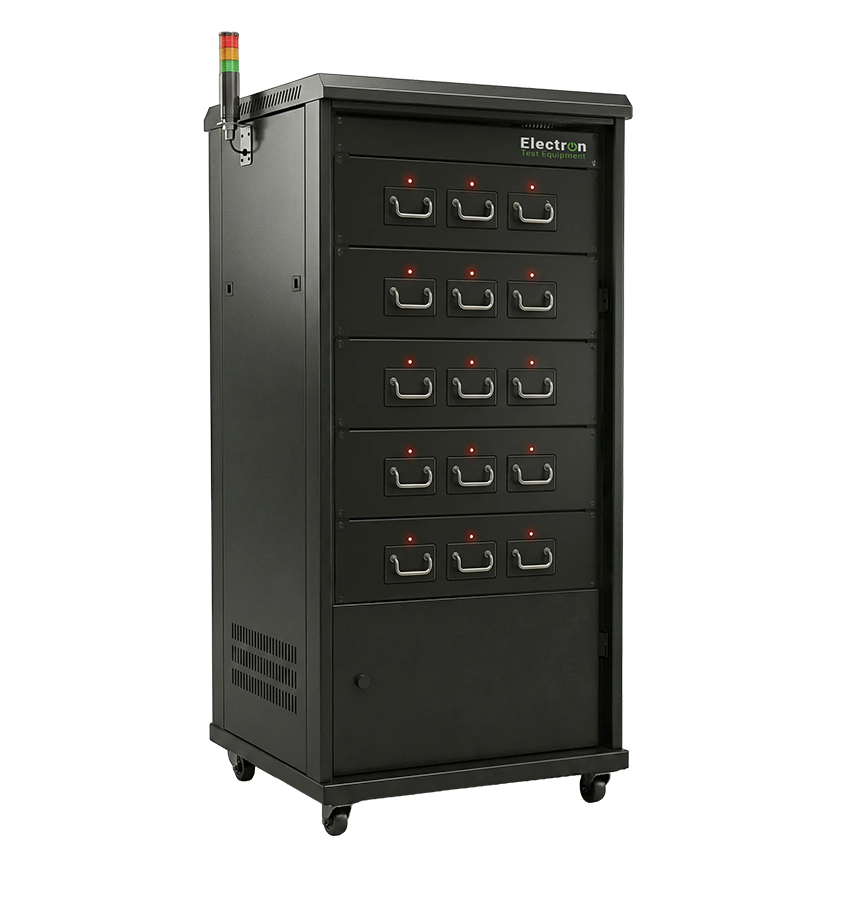
The 4000 Series is a custom-engineered TEC temperature-controlled laser diode test system for burn-in, reliability, and life testing, with DUT drawers for fast changeovers across laser diode packages. Engineered for laser diodes ranging from 20 mA to 30 A.
Trusted by Semiconductor Manufacturers & Government Institutions
Versatile Laser Diode Testing
The 4000 Series Laser Diode Test System is designed for versatility, enabling testing across multiple component packages and drawer temperatures.
Cost-Effective
Our cost-effective laser reliability test systems delivers scalable solutions that ensure high-quality performance and reliability while optimizing your testing budget.
Engineering Support
Our team provides exceptional support from design to comissioning. We help engineering teams with custom automatic test equipment & semiconductor testing solutions.
TEC Controlled Laser Diode Test System | 4000 Series Specification
| Reliability Test | FIT (Failure In Time), MTTF (Mean Time to Failure) |
| Measured Quantities | Optical Power, Current, Forward Voltage (LIV), Temp |
| Type of Mode of Operation | ACC, APC, LIV ACC, LIV (30 A Laser Diode Only) |
| Laser Types | CoC, CoS, TO-CAN, Butterfly, Optical Communication Laser Modules, Custom Laser Assembly Modules |
| Number Test Components | 64 - 4096 (200 mA Laser Diode) 64 - 2944 (2 A Laser Diode) 16 - 64 (30 A Laser Diode) |
| Current Range | 4 mA – 200 mA (200 mA Laser Diode) 1 mA – 5,000 mA (2 A Laser Diode) 0 A - 30 A (30 A Laser Diode) |
| Current Accuracy (Measured) | 0.1% of Full Scale |
| Source Measure Board | DUT - Custom Interface Test Fixture |
| Current Sweep | Up to 650 mA (200 mA Laser Diode) Up to 650 mA (2 A Laser Diode) Up to 30 A (30 A Laser Diode) |
| Maximum Current | 650 mA (200 mA Laser Diode) 1500 mA (2 A Laser Diode) 30 A (30 A Laser Diode) |
| Optical Power | SI or InGaAs Photodiode |
| Cooling | TEC Air Cooled Ambient to 125°C |
| TEC Temperature Stability | ± 0.3 °C (200 mA / 2 A) ± 0.5 °C (30 A) |
| Input Voltage | 110V - 240V AC |
| Power Consumption | 500 Watts (200 mA / 2A) 1000 W Plus Laser Load (30 A) |
| System Dimensions (mm) | 600 (W) × 1000 (D) × 2000 (H) (size based on 128 component testing for 200 mA & 2 Amp Lasers or 30 components testing for 30 A) |
| Material: | Aluminum/Steel |
| Automatic Constant Current | In ACC mode the laser diode’s output power is held constant by continuously adjusting current as required to maintain constant output power. The system Optical output power is measured by using an internal monitor photodiode if one is available within the laser. |
| Light Current Voltage (L-I-V) | By applying increasing current to the laser diode so it that emits light, the optical output is measured together with the voltage drop across the diode element. The resulting LIV curve reveals important clues about the quality of manufacture and the performance of the laser diode. |
| Automatic Power Control | In APC mode, the system monitors the optical output and provides a control signal for the laser diode which maintains the operation at a constant optical output level. Optical output power is measured either with an external or photodiode within the laser. |
4000 Series Laser Diode Burn-in & Reliability Testing
The ATE-LD-XXXX-4000 Series provides low-cost, high-performance accelerated aging, burn-in testing, and qualification testing for laser diode reliability. It uses precise control, allowing the user to test from 64 up to 4,096 laser diodes in modular drawers.
The 4000 Series can perform burn-in testing to accelerate the aging process of the laser diodes. This helps identify any potential failures early and ensures the long-term reliability of the diodes.
Catastrophic optical damage can occur in a laser’s optical system if the optical output exceeds the threshold, making laser diode qualification essential.
LIV Testing for Laser Diodes
The ATE-LD-XXXX-4000 Series provides light-current-voltage (LIV) sweep testing, which is a fundamental measurement to determine the operating characteristics of a laser diode. The LIV Test System is designed for applications that require the highest measurement accuracy and testing of up to 4,096 laser diodes at the same time.
Optical Power Monitoring
The 4000 Series can be equipped to measure the optical output power using a photodiode, which is crucial to ensure reliable performance.
High power diodes are crucial in applications such as laser systems and telecommunications, where they must reliably handle large amounts of electrical current without failure.
Key Advantages of the 4000 Series
Laser Diode Test System
The ATE-LD-XXXX-4000 Series Laser Diode Test Systems are designed for versatility, enabling testing across multiple component packages and temperatures for each drawer.
The systems are equipped to measure optical power accurately, ensuring reliable performance assessments during L–I–V characterization by evaluating the relationship between optical power and current.

Primary Advantage
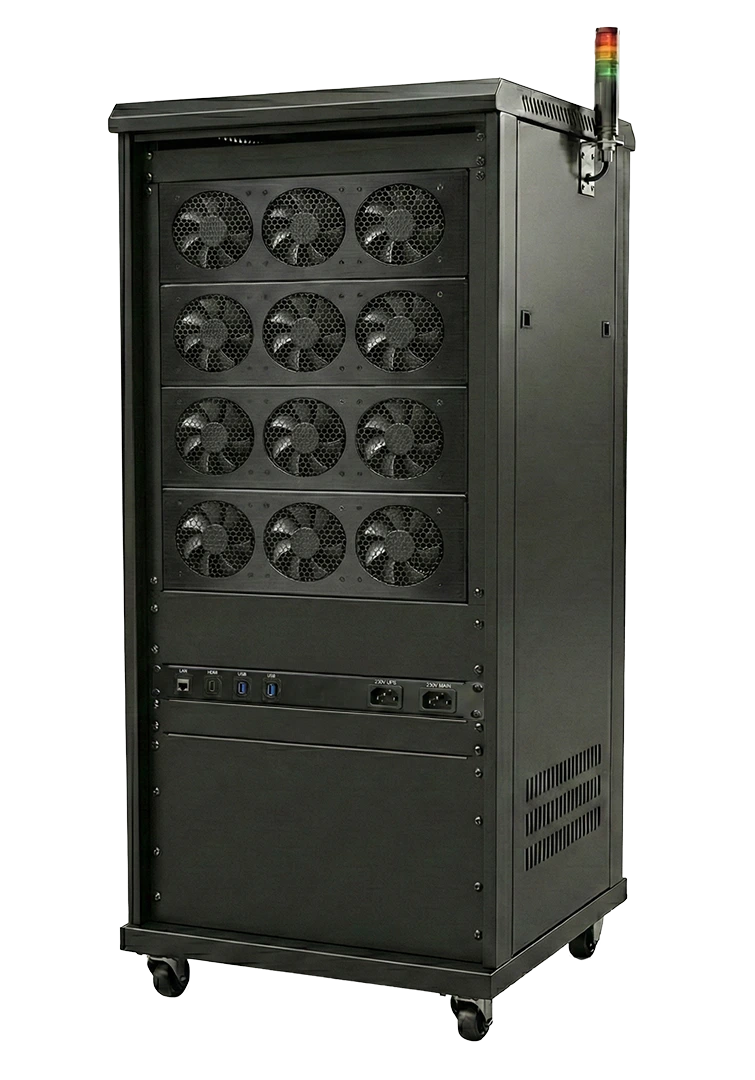
Fully customized reliability system combining scalable capacity, modular drawer maintenance, and dedicated TEC thermal control.
No Water Cooling Required
No water or liquid cooling is required, ensuring low maintenance, increased reliability, and a clean operational environment.
Configuration & Scalability
Accommodates 64 to 4,096 lasers, allowing capacity growth by adding modules as production and reliability testing requirements increase.
Platform Versatility
A single unified platform supports engineering, qualification, and high-volume burn-in testing.
Maintenance & Serviceability
Individual drawers can be independently accessed, serviced, or modified without interrupting system operation.
Thermal Control
Dedicated TEC temperature control system per drawer, engineered around the customer’s specific laser and thermal load.
Dedicated Support & Diagnostics
Secure remote access allows Electron Test Equipment engineers to assist your testing team in real time and resolve technical inquiries quickly.
DUT Fixturing & Package Support
Features custom laser package integration and dedicated DUT fixtures with 16 laser diodes per drawer.
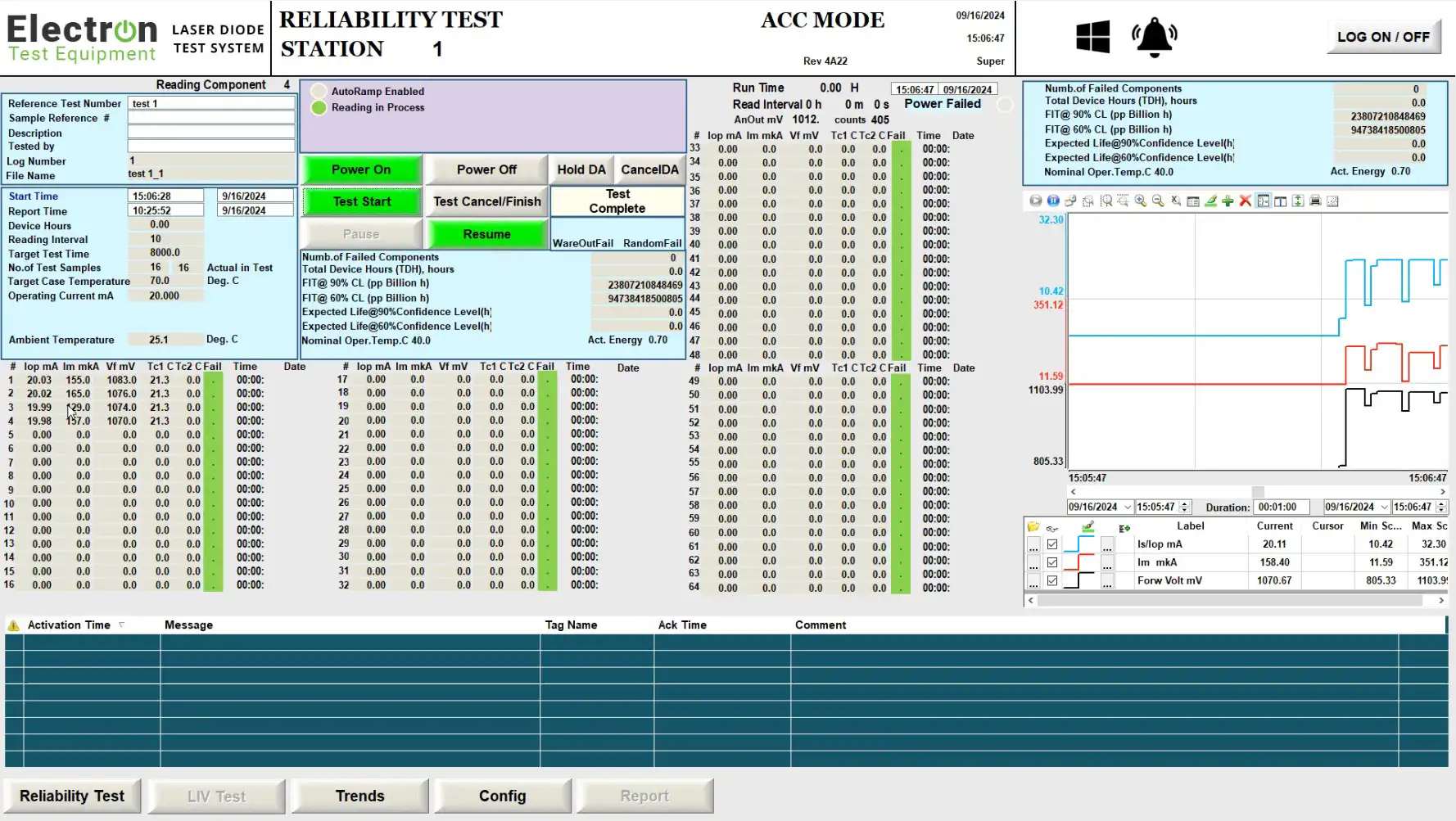
Easy-to-use Software
Our user-friendly software interface and robust data management system facilitate easy operation and efficient data handling.
Case Studies
for Global Semiconductor Manufacturer
Powerful Software Interface
- An easy to use GUI provides real-time testing and functional reports
- Multiple test scenarios (recipes) are easily configured without complicated programming
- FIT (Failure in Time) & Mean Time to Failure (MTTF) calculation
- LIV Curve, Threshold Current, Operating Current, Forward
- Voltage, Monitoring Current and Data Collection
- Designed for use by Operators & Supervisors
- E-mail notification
- Export to Reporting Dashboard (PowerBI, etc.)


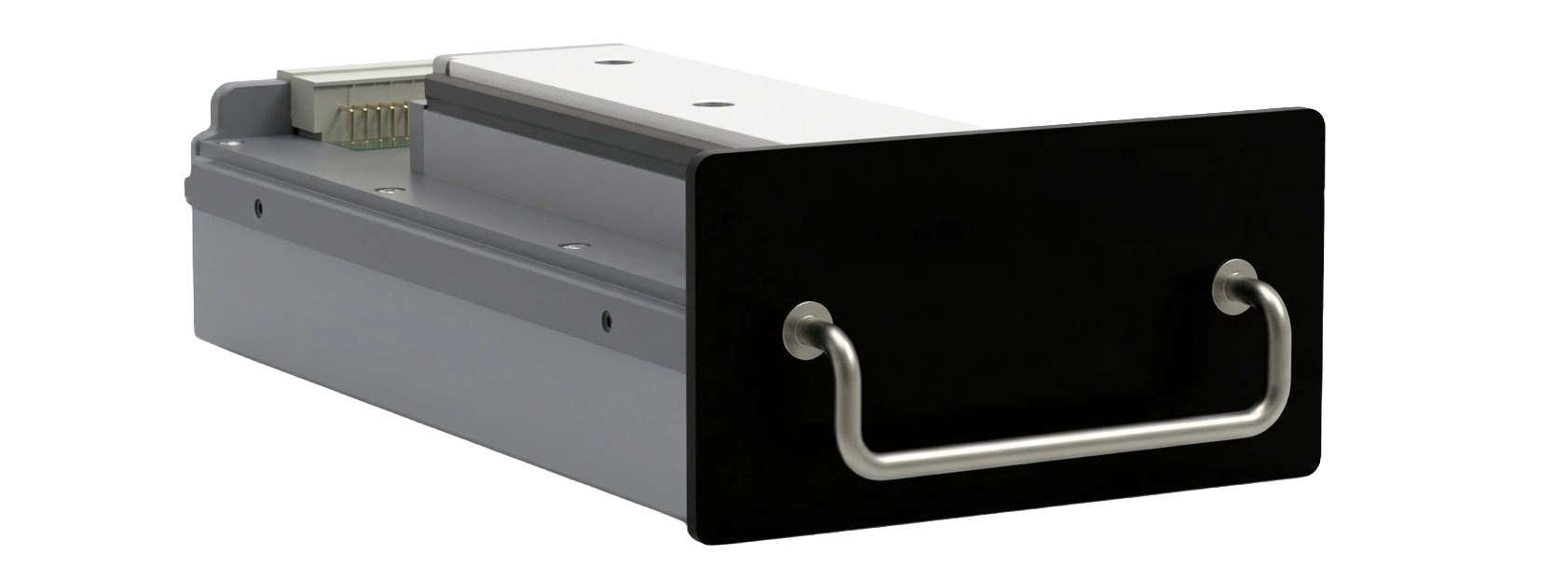
Custom TEC Temperature DUT Board
- Each module allows separate temperature and measurement settings for 16 laser diodes per module.
- TEC thermal control within ± 0.3 °C for lasers operating at up to 2 A and ± 0.5 °C for lasers operating at 30 A.
- Designed to operate up to 125°C.
- DUT package types include: CoC, CoS, TO-CAN, Butterfly, Optical Communication Laser Modules, and Custom Laser Assembly Modules.
- No water cooling required. The system utilizes TEC thermal management heat transfer technology that provides precise TEC thermal control.
Resources
Laser Diode Datasheets, Case Studies, & Brochure
To access, please provide your:
The light current and voltage are key factors in determining the optical output power of a laser diode. A significant voltage drop can negatively affect the output power and reduce the overall optical output efficiency.
Our laser diode testing systems come with advanced software test configurations. You can customize settings that meet various organization test standards such as the Telcordia (Bellcore) GR-468-CORE, MIL-STD-883E, and Test Method 1016.
Reliability laser diode testing plays a critical role in ensuring the performance and longevity of laser diodes used in various applications. A comprehensive test system is used for optically tested diodes, where burn in testing and life tests are conducted to simulate long-term usage and stress. Through batch testing, manufacturers can identify any weaknesses in production runs, while qualification testing ensures that each laser diode meets the necessary standards for reliability. A robust reliability test system is essential for consistent reliability testing, offering accurate data that helps predict the expected lifespan and operational stability of each diode.
TEC Controlled Laser Diode ATE
TEC temperature controlled laser diode reliability and burn-in
Both the 2000 Series & 4000 Series laser diode test systems provide burn-in testing to detect microscopic defects and ensure that laser diodes deliver stable optical output and consistent slope efficiency over time. During laser diode qualification, key factors such as output power, voltage drop, and near field performance are evaluated to ensure high power operation and reliability. Accelerated aging is a cost-effective method to test laser diodes, verifying their durability while maintaining optimal optical power and ensuring they are optically tested for maximum efficiency. Semiconductor diodes are placed in an environmental chamber at a set temperature and current and is applied to the laser diodes at interval steps (LIV test sweep) and the intensity of the resulting emitted light and voltage is measured. The final laser diode LIV test results are displayed onto a graph which is known as an “LIV curve”. The following characterization can be determined based on the LIV measurement: Power vs. current ; Power vs. voltage ; Threshold current ; Series resistance ; Slope efficiency. With the rapid advancements in the electronics industry, reliability is a concern in every laser diode testing application. Laser diode life testing or accelerated aging is extremely important as part of qualification during product development as well as for batch testing throughout the production life of the laser. Also, high-temperature burn-in tests are used in laser diode manufacturing to filter out components prone to premature failure and ensure the remaining lot of laser diodes will meet the acceptable level of reliability based on the test standard used. Laser diode qualification involves rigorous testing to validate the diode's readiness for specific applications. Each diode is optically tested to ensure its optical output meets the required specifications without excessive degradation over time. Testing also ensures the diode delivers consistent output power under varying conditions. This qualification process is essential for achieving reliable laser performance while maintaining a low cost for high-volume production. By analyzing the resulting LIV curve, engineers can assess key characteristics like slope efficiency, which indicates how efficiently the diode converts electrical input into light. Proper testing also helps identify any issues with the diode element, reducing the risk of failures like catastrophic optical damage that could compromise the system's performance. Burn-in testing is often conducted to simulate real-world conditions and confirm the mean time to failure, ensuring long-term reliability. No, all semiconductors need to be packaged in order to mount them to the customer DUT (device under test) boards. Our dedicated support staff provides outstanding training and will help your team configure the software for your laser diode testing application. Depending on your requirements, the software can be customized to meet your semiconductor test requirements. When you choose an Electron Test Equipment product you not only get the most advanced semiconductor test equipment – you receive outstanding support and service.How does the Laser Diode Test System works?
How Does The LIV Test System Works?
Why Use Accelerated Lifetime Testing & Burn-in for Laser Diodes?
How is Laser Diode Qualification Performed?
What is the Importance of Laser Diode Testing?
Does your equipment work with unpackaged components?
How does Electron Test Equipment provide training & support?
Laser Diode Testing
Quote Request
Need a custom laser diode reliability & burn-in test solution? Submit your requirements, and our application engineers will create a custom solution.
HEAD OFFICE
Electron Test Equipment Limited
5a Whytecliffe Road South, Purley, CR8 2AY, England
Phone: + 44 1293 904 001
E-mail:
moc.tsetnortcele@su-tcatnoc